Field note 01 / Drafting
Knute Can Draft Your ESPN Fantasy Football Team: Three Real 2026 Drafts
One AI GM. Three live ESPN drafts. Three different league shapes.
The short answer
Can AI draft my ESPN fantasy football team?
Yes. Knute can draft your ESPN fantasy football team live. It does not stop at recommending a player for you to click. When you arm a supported ESPN snake draft, Knute follows the room, decides from the players still available, sends the pick for your team, and confirms that the room accepted it.
I know because I used it on my own ESPN account. In 2026, Knute drafted three teams for me: a 10-team PPR team, an 8-team PPR superflex team, and a 10-team non-PPR team.

A note from the founder
I wanted evidence from a real draft room.
I did not want to publish another synthetic mock or a list of players an AI said it might draft. I connected my own ESPN account and let Knute do the part that matters: follow a live room, make the decisions and finish the teams.
I also wanted the test to cover meaningfully different problems. A 10-team PPR league, an 8-team superflex league and a 10-team non-PPR league should not produce one generic board wearing three different labels. The scoring and starting slots change what scarcity means, so they have to change the way Knute values the room.
01 / Live execution
Can Knute draft my ESPN fantasy football team?
Yes, for supported ESPN snake drafts. You connect your team, choose a draft strategy and an available model in Knute, install the fallback queue, and arm the live draft.
Knute reads the league size, scoring settings, starting slots, roster and live draft board. It works from that league's actual shape and the players still available, not from a generic list frozen before the room opened.
Auction drafts are not supported by this live workflow. That boundary matters: these three rosters show what Knute has done in snake drafts, not what it might do in every draft format.
02 / Decision loop
How does Knute make live draft decisions?
The system separates slower planning from the moment your pick is on the clock.
-
01
Shape the room
League size, scoring, roster slots, your current roster and the live board become the decision context.
-
02
Prepare a safe board
A deterministic draft engine builds the current candidate order. Before the live session starts, Knute verifies that its ordered fallback queue is installed in ESPN.
-
03
Plan off the clock
The selected model can reorder a bounded shortlist of up to five already-eligible players. It cannot introduce a player outside that list. If the model is slow, unavailable or returns an invalid order, deterministic drafting continues.
-
04
Pick, then verify
No model call happens on the draft clock. Knute sends from the prepared order, then treats the pick as complete only after the live room reports the selection for your team.
03 / Rankings into decisions
How did Knute use its rankings to build these teams?
The rankings were a starting value map, not autopilot instructions. We designed Knute to begin with projected performance and then ask how much harder a player would be to replace at his position in this specific league. That value-over-replacement view prevents raw projected points from automatically pushing quarterbacks to the top of every format.
That distinction matters. In a typical 10-team, one-quarterback league, the replacement quarterback can remain relatively strong even when quarterbacks lead the league in projected points. A starting running back may therefore carry more draft value because the drop to the next usable running back is steeper. In superflex, extra starting quarterback demand changes that scarcity calculation.
Then the room starts moving. Knute removes drafted players, re-reads its open starter slots and roster balance, applies manager preferences, respects position limits and looks for tier cliffs. The board rank stays as a stable reference; the live roster-adjusted rank decides how that value fits the team now.
-
Value map
Project, then price replacement.
The baseline combines projected performance with the league's size, scoring and starting slots instead of sorting every position by raw points.
-
Live fit
Re-rank what is still possible.
Availability, open starters, roster depth, position limits, manager rules and the next tier drop reshape the effective order as the draft unfolds.
-
Guardrails
Keep judgment inside a safe shortlist.
The selected model can reorder only players the deterministic engine has already approved. It cannot reach outside the eligible group to improvise a different pick.
What I see in the outputs
10-team PPR
Burrow anchors quarterback while Nacua, Bowers, Jeanty and Williams create a balanced core across the scarcer skill positions.
8-team superflex
Daniels and Hurts occupy both quarterback-capable starter spots, with Shough in reserve. The format's extra quarterback demand is visible in the roster shape.
10-team non-PPR
Allen and Robinson lead a different construction around three starting receivers and a flex, reflecting a room with different scoring and starter requirements.
These are observations from the final rosters, not reconstructed explanations for any single pick. A finished team shows the shape of the result; it does not preserve every live tradeoff that produced it.
04 / Simultaneous drafts
Can Knute draft multiple leagues at the same time?
Yes. Each connected team gets its own independent draft session, live board and stop control. I also confirmed Knute working across overlapping drafts.
The standard limit today is two active draft sessions per account. So "multiple" means two at once, not an unlimited number of simultaneous rooms.
05 / Draft position analysis
Where did each player come off the board?
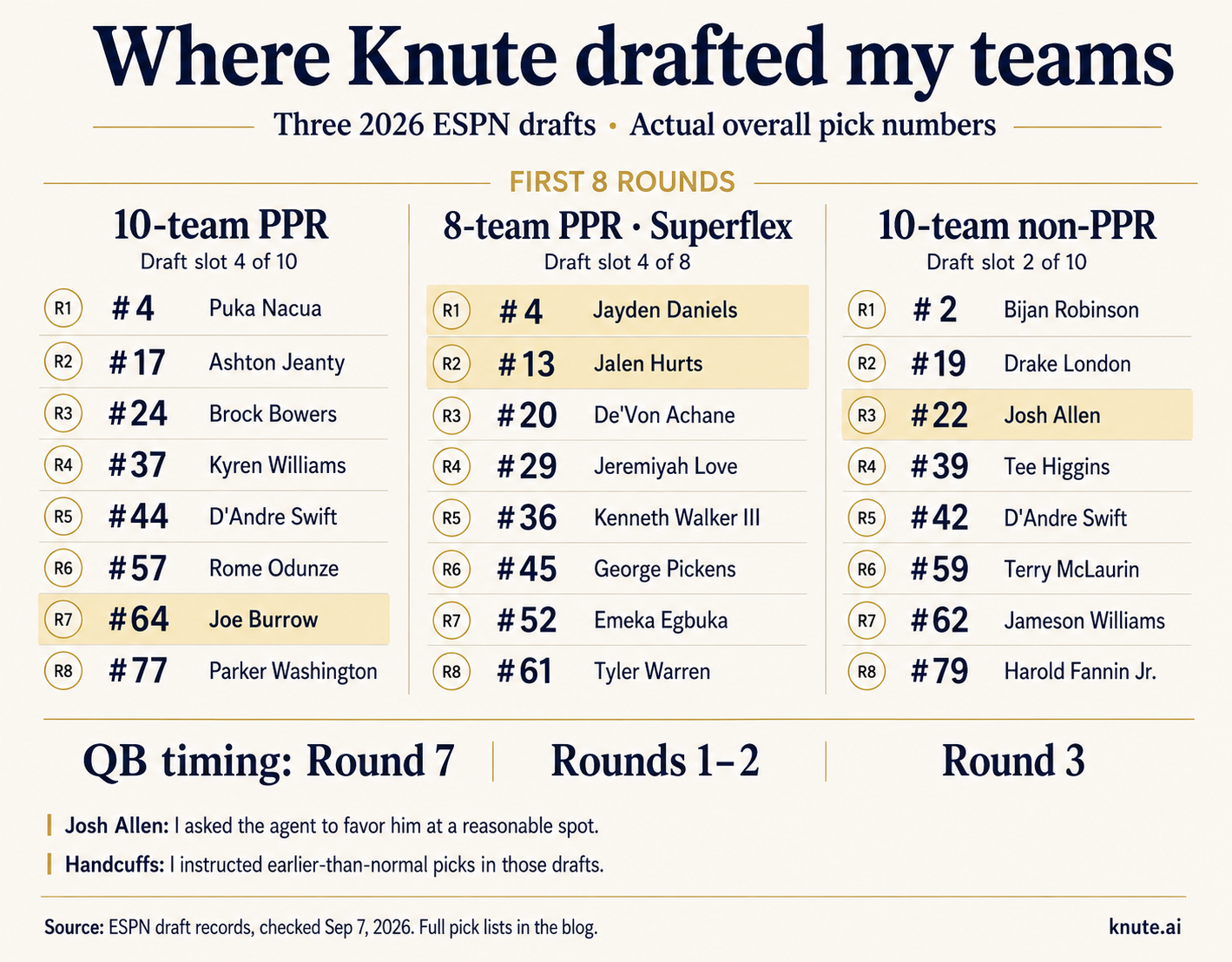
The pick order makes the differences between these teams easier to see. In PPR, Knute spent six rounds on running backs, receivers and a tight end before taking a quarterback. In superflex, it opened with two quarterbacks. In non-PPR, it took Josh Allen in round 3 after Bijan Robinson and Drake London.
My instructions were part of the draft. I had given the agent a bias toward drafting Josh Allen at a reasonable spot. It selected him at 3.02, No. 22 overall. In the drafts with handcuffs, I also instructed the agent to draft handcuffs earlier than normal. Those picks should be read with that preference in mind.
10-team PPR / Slot 4
Build the core, then take a QB.
Puka Nacua at No. 4, Ashton Jeanty at 17, Brock Bowers at 24 and Kyren Williams at 37 gave the team two running backs, a receiver and a tight end through four rounds. D'Andre Swift at 44 and Rome Odunze at 57 filled out the skill-position starters before Joe Burrow at 64, in round 7.
The tradeoff was visible: Bowers cost a third-round pick, while quarterback could wait. The bench came next, including Brian Thomas Jr. at 97, Jacory Croskey-Merritt at 104 and Jordan Mason at 117. Kicker and defense were the final two picks.
8-team PPR superflex / Slot 4
Pay for both quarterback slots.
Jayden Daniels at No. 4 and Jalen Hurts at 13 used the first two picks on quarterbacks. De'Von Achane at 20, Jeremiyah Love at 29 and Kenneth Walker III at 36 followed. The first receiver was George Pickens at 45, in round 6, then Emeka Egbuka at 52.
That is the cost of securing two quarterbacks early: receiver and tight end come later. Tyler Warren went at 61, Courtland Sutton at 68 and a third quarterback, Tyler Shough, at 77. Travis Kelce at 109 added tight-end depth; Chuba Hubbard at 125 and Aaron Jones Sr. at 132 added late running-back depth.
10-team non-PPR / Slot 2
Make room for my Allen preference.
Bijan Robinson at No. 2 and Drake London at 19 came before Josh Allen at 22. My preference for Allen meant spending a third-round pick on quarterback, compared with a seventh-round pick in the other 10-team draft. Tee Higgins at 39, D'Andre Swift at 42, Terry McLaurin at 59 and Jameson Williams at 62 followed.
Harold Fannin Jr. at 79 completed the offensive starters. Kyle Monangai at 82 was the first bench pick; Brian Robinson Jr. at 102, Woody Marks at 119 and Kaelon Black at 142 added running-back depth. My instruction to prioritize handcuffs earlier is relevant when judging that allocation. Tank Dell was the final recorded pick, No. 179, and appears in the original roster's IR slot.
Source: ESPN's saved 2026 draft pick records, checked September 7, 2026. These are actual pick positions, not average draft position (ADP). The analysis describes how the picks built each roster; it does not establish that a player was a bargain or a reach against a draft-day market.
The non-PPR record contains 18 selections. Harrison Mevis appears on the original roster but not in that team's saved draft picks, so he is listed without a pick number. ESPN currently labels that league's draft setting OFFLINE; its saved pick list establishes selection order, not the live execution path.
06 / Every recorded pick
Which league formats has Knute drafted?
These are the complete rosters from my three 2026 ESPN drafts, now listed in draft order. Each entry shows the round, pick within that round and overall pick number. For example, 3.02 means round 3, pick 2; in a 10-team league, that is No. 22 overall. Starter, bench and IR labels preserve the roster snapshot from the original post.
01
10-team PPR
16 players
| Draft pick | Player |
|---|---|
| 1.04 No. 4 overall | Puka Nacua Starter / WR |
| 2.07 No. 17 overall | Ashton Jeanty Starter / RB |
| 3.04 No. 24 overall | Brock Bowers Starter / TE |
| 4.07 No. 37 overall | Kyren Williams Starter / RB |
| 5.04 No. 44 overall | D'Andre Swift Starter / FLEX |
| 6.07 No. 57 overall | Rome Odunze Starter / WR |
| 7.04 No. 64 overall | Joe Burrow Starter / QB |
| 8.07 No. 77 overall | Parker Washington Bench |
| 9.04 No. 84 overall | Tucker Kraft Bench |
| 10.07 No. 97 overall | Brian Thomas Jr. Bench |
| 11.04 No. 104 overall | Jacory Croskey-Merritt Bench |
| 12.07 No. 117 overall | Jordan Mason Bench |
| 13.04 No. 124 overall | Trevor Lawrence Bench |
| 14.07 No. 137 overall | Makai Lemon Bench |
| 15.04 No. 144 overall | Cam Little Starter / K |
| 16.07 No. 157 overall | Eagles Starter / D/ST |
02
8-team PPR
Superflex
19 players
| Draft pick | Player |
|---|---|
| 1.04 No. 4 overall | Jayden Daniels Starter / QB |
| 2.05 No. 13 overall | Jalen Hurts Starter / SF |
| 3.04 No. 20 overall | De'Von Achane Starter / RB |
| 4.05 No. 29 overall | Jeremiyah Love Starter / RB |
| 5.04 No. 36 overall | Kenneth Walker III Starter / FLEX |
| 6.05 No. 45 overall | George Pickens Starter / WR |
| 7.04 No. 52 overall | Emeka Egbuka Starter / WR |
| 8.05 No. 61 overall | Tyler Warren Starter / TE |
| 9.04 No. 68 overall | Courtland Sutton Starter / WR |
| 10.05 No. 77 overall | Tyler Shough Bench |
| 11.04 No. 84 overall | Michael Pittman Jr. Bench |
| 12.05 No. 93 overall | DK Metcalf Bench |
| 13.04 No. 100 overall | Matthew Golden Bench |
| 14.05 No. 109 overall | Travis Kelce Bench |
| 15.04 No. 116 overall | Jakobi Meyers Bench |
| 16.05 No. 125 overall | Chuba Hubbard Bench |
| 17.04 No. 132 overall | Aaron Jones Sr. Bench |
| 18.05 No. 141 overall | Steelers Starter / D/ST |
| 19.04 No. 148 overall | Eddy Pineiro Starter / K |
03
10-team non-PPR
19 players
| Draft pick | Player |
|---|---|
| 1.02 No. 2 overall | Bijan Robinson Starter / RB |
| 2.09 No. 19 overall | Drake London Starter / WR |
| 3.02 No. 22 overall | Josh Allen Starter / QB |
| 4.09 No. 39 overall | Tee Higgins Starter / WR |
| 5.02 No. 42 overall | D'Andre Swift Starter / RB |
| 6.09 No. 59 overall | Terry McLaurin Starter / WR |
| 7.02 No. 62 overall | Jameson Williams Starter / FLEX |
| 8.09 No. 79 overall | Harold Fannin Jr. Starter / TE |
| 9.02 No. 82 overall | Kyle Monangai Bench |
| 10.09 No. 99 overall | Michael Wilson Bench |
| 11.02 No. 102 overall | Brian Robinson Jr. Bench |
| 12.09 No. 119 overall | Woody Marks Bench |
| 13.02 No. 122 overall | Wan'Dale Robinson Bench |
| 14.09 No. 139 overall | Rashid Shaheed Bench |
| 15.02 No. 142 overall | Kaelon Black Bench |
| 16.09 No. 159 overall | Tre Tucker Bench |
| 17.02 No. 162 overall | Bills Starter / D/ST |
| 18.09 No. 179 overall | Tank Dell IR |
| Not in draft record | Harrison Mevis Starter / K |
07 / The honest result
What do these rosters prove?
They demonstrate that Knute can complete real ESPN fantasy football drafts across different league sizes, scoring systems and roster requirements. They also show the product doing the work instead of stopping at draft advice.
They do not prove future wins, forecast a final standing or guarantee fantasy performance. Injuries, real player performance, league opponents and in-season moves all matter after draft night. This is a capability report, not a victory claim.
Your next draft
Put Knute in the draft room.
Get Knute on iPhone, connect your ESPN team and keep control of the strategy and the stop button.